Every teacher I know has a strong book habit; they collect them, read them, share them and talk with passion about their favorites. I’m no different, although as I begin to understand my stress around clutter, I have reduced the number of books I own and I only buy those I truly love.
Every few years, I sort and get rid of some, but last spring I was brutal when I went through them. I donated almost 200 books and added that same amount into my home reading program. This resulted in a classroom library filled with only books that I’m eager to read and share with my class.
I have two book shelves in my classroom. I use one for fiction and one for non-fiction. I also have two plastic bins – one for ABC books and one for math books.

This arrangement has changed over time.
- When I first taught K, I had one bookcase that I would change occasionally.
- I started changing them monthly.
- When I moved to grade one, I still had the one bookcase but I also had many bins with leveled readers.
- I acquired the second bookcase for non-fiction.
- Then I moved back to K, stored the leveled readers but continued to have bins for a variety of topics.
- Now I just have the two bookcases and two bins.
I LOVE how my books are sorted and used in the classroom. My students are eager for book-time as they always have new and interesting books to look at and read.

Fiction
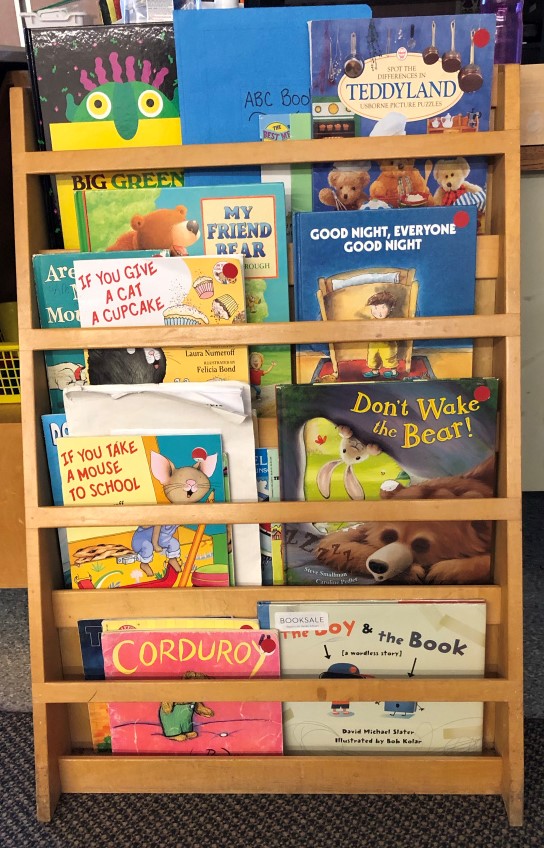
My fiction books are traded out monthly. Some of them are themed books but most aren’t. Although, I do have a Christmas book problem so I keep my November books out for some extra time to add in some variety.
I find changing the books keeps the interest high. During the month, I read some of but not all of these books. Occasionally, the students have a favorite book that I will keep out for them to continue reading.
Each book on this shelf has a small red sticker to help guide the students in clean up. One of my classroom jobs is library helper; their job is to arrange the books and keep them tidy. In the photos, you can see that they are doing a good job, although I need to replace a few stickers.
I have storage shelves where the rest are stored. I have a simple paper marker with the months so divide them for me. At the beginning of each month I do a quick swap so it’s not labor intensive for me.

Non-Fiction
My non-fiction books are traded out at different times. Sometimes the books are a topic I’m teaching and they get put away at the end of the unit. Sometimes, they are just interest books and I put them away when the students stop reading them.
When I sorted them, I let the books guide my groupings. Some groupings have an assortment of non-fiction and fiction. Farm for example, has both, as it gives us a good opportunity to discuss what the differences between fiction and non-fiction are. I generally put out the farm books first and it’s a good way to start the year.
As with my fiction books, these are on my storage shelves, divided by paper markers with the topic. Each of these books has a blue sticker.

My Teaching Books
I also have a collection of books that I use for teaching. These would be the ones I use for lessons. All of my alphabet, math and rhyming books are on these shelves. It also includes science books that span topics, books I use for interactive read-alouds and my favorite story books.
Every year, my goal is to read and use all of these books but I’ve been unable to do it yet. Maybe this is the year.

School Library
It’s been easy for me to reduce the amount of books I purchase because we have an amazing library at my school. I can easily supplement from there.
Not only is our book selection good but our librarian makes thoughtful purchases and buys books that are current and cover the topics we teach most. She is often willing to buy the books that we ask for but she is also continually searching for the best new books. Our school is lucky to have such a librarian.

How will you organize your classroom books?
You do need to find the organization system that works best for you, the way you teach and the students you have.
Teaching kindergarten in Canada, means that I do not need to teach my students how to read. I do need to teach them prereading skills and I do need to teach my students whom are already reading or begin reading during the year.
To meet my prereaders needs, I provide many high interest books in a variety of topics. If they ask me to read one of the books, I do, on the day they ask me.
For my beginning readers, I have a collection of decodable books that we start with. The way that I teach the alphabet, students are able to begin reading these early books right away. Since, I have no obligation to teach them to read it is all student driven. I love the joy they find when they can read mat, sat or map.
My readers, happily read the books provided on the bookshelves. If I notice they prefer a certain type of book, I will find some for them.
The first part of organization is getting rid of what you don’t love. Are you willing to part with some of your books?




Leave a Reply