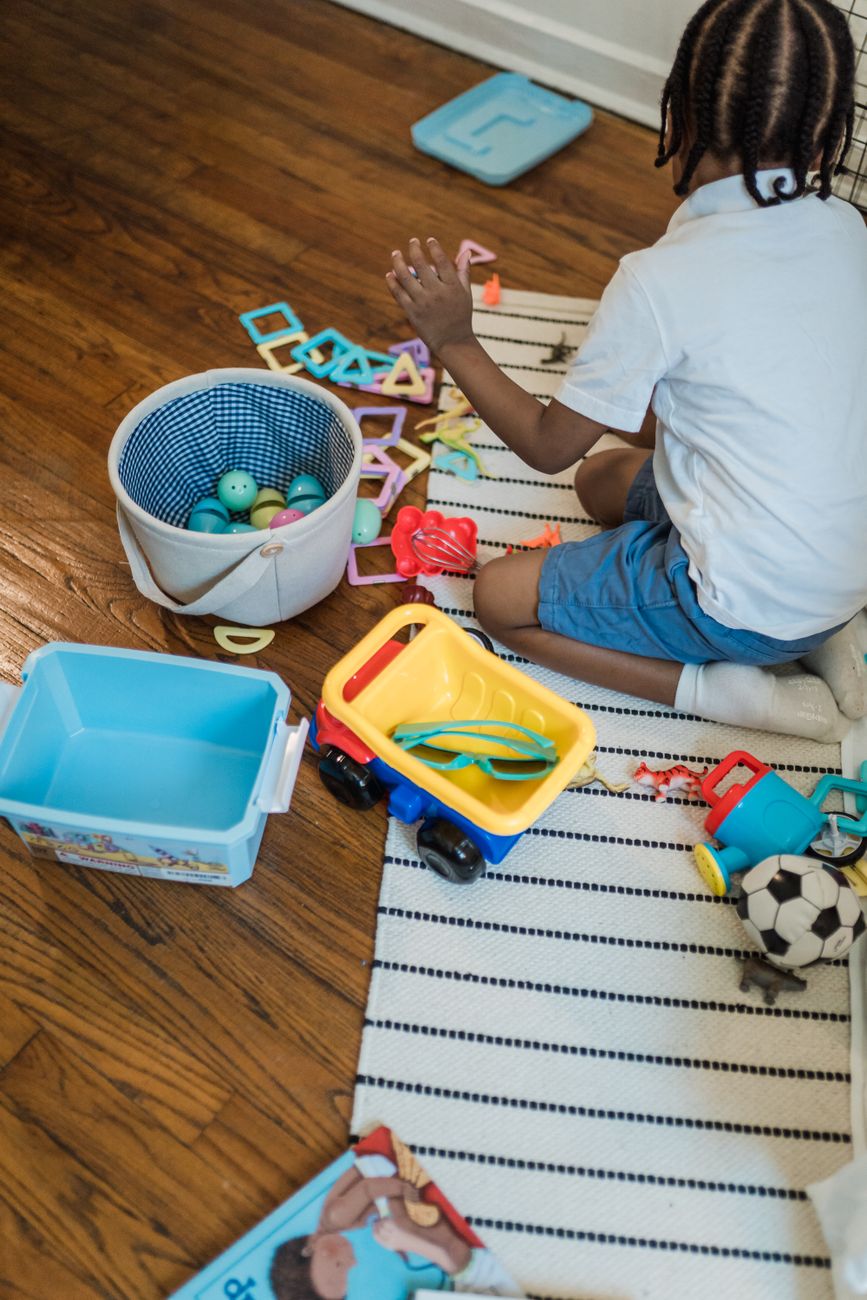
Every year, I have students that don’t know how to play with other children in a classroom setting. They will roam the room, break their classmates’ creations, dump out bins and not settle into an activity. There can be many reasons for this but my goal becomes teaching them how to play and have meaningful fun. Each child’s play will look different so success also looks different. Documentation will help you see growth and provide new insight to your student.
Here are a few things that I do with the non-playing student.
- Let the child lead. Give them time to watch their classmates and get a feel for the classroom. This is a new space and some students need time to feel safe and comfortable enough to play.
- Support. Non-players often take a long time to choose where they want to play and may transfer quickly from toy to toy. As they are moving, I will talk to them about their options and I will point out the other children and talk about what they are doing. Sometimes, a connection with a new friend will encourage a child to try out toys.
- Play with the student. When a non-player stops at a toy, I might initiate play. I could directly ask them to play with me or I will just talk about how I’m playing and hope they join in.

Here are a few things that I do whole class.
- Toy tours. Early in the year, I set out the toys that are ‘open’ (can be played with). As a class we do a quick tour to check out all the toys and discuss what we can do with them. This gives all the children a chance to think about what they want to do during playtime and plan what and how they want to play. It gives a non-player an opportunity to hear their peers talk about different options.
- Imaginative play support. I will read a book with one main character. David books by David Shannon work well for this. No, David! is the one that I always start with. I read the story once, then pass out a small block to each child. During the second reading, the students pretend that their block is David. They act out the story with the block as I read. This activity promotes imaginative play in a controlled setting. I will do this same activity with many stories through the year adding more blocks for more characters. I generally don’t plan which books I do this with but will chose based on the student’s excitement for a story.
- Puppet play. I plan activities where the students make a paper puppet and we act out a story or rhyme. I will make these with clipart or offer a small blank piece of paper for the students to draw their character. Once they have their character, they tape a popsicle stick to the back and are able to retell or make their own story. Students who have a hard time playing often plan violence for their puppet so it’s important to give them a story structure.
- Joining play. Whole group I will teach the students how to join into a group that is already playing. I will have a small group pretend playing and I will be the joining student. I will join a few different ways (taking their toys, sitting near them, sitting with them, waiting to be invited, crying, tattling), we will have a class discussion about how to join. It is very helpful for students to hear that others also have a hard time joining in. My go-to question for students to ask is, “What can I do?” This sets it up so the joining child is given a task by the other players. Children often ask, “Can I play? but this allows the other children to say No. We don’t want that.
Be consistent. Keep to the same playtime format as much as possible. When you need to make changes, give the students all of the details and have a discussion about how the playtime will look the same as normal and how it will be different.
Once you notice that your non-player is playing try to have their preferred toy ‘open’ at all playtimes. Once they are extremely comfortable, they might be open to trying something new or not. If they are resistant then one way to encourage an expansion of materials is to add something new to their preferred toy. If they love building with Lego, add some cars to the Lego area. They might ignore them or they might start adding garages to their buildings. Eventually, they might just play with cars one day.
Timing can be a problem with non-players. When they take a long time to chose to play their playtime can be quite short. Frustration can set in and it makes for a difficult transition. I work with this in several ways. I might have an area in the classroom that their toy can stay set up until the next day. I might allow them to continue playing for another few minutes or I might take a picture of what they did but either way I talk with them about their feelings. I make sure that they know that it can be played with again the next day.
Teaching a child to play can be a quick process as they get comfortable in the classroom or it might be a full year of teaching and learning. Having lessons on self-regulation, and friendship skills will help the non-player learn how to interact with their classmates and have fun during playtime.
Make sure to discuss your observations with their families. This often gives you insight into their behaviour, and help you support them better. Having a good connection with you will make all the difference in your non-player feeling comfortable enough to play and have fun.
Check out this post about starting a playtime in your class. https://teachingwithtracey.com/2026/08/05/effective-free-play-strategies-for-starting-a-playtime-in-kindergarten/
Take care,
Tracey



Leave a Reply