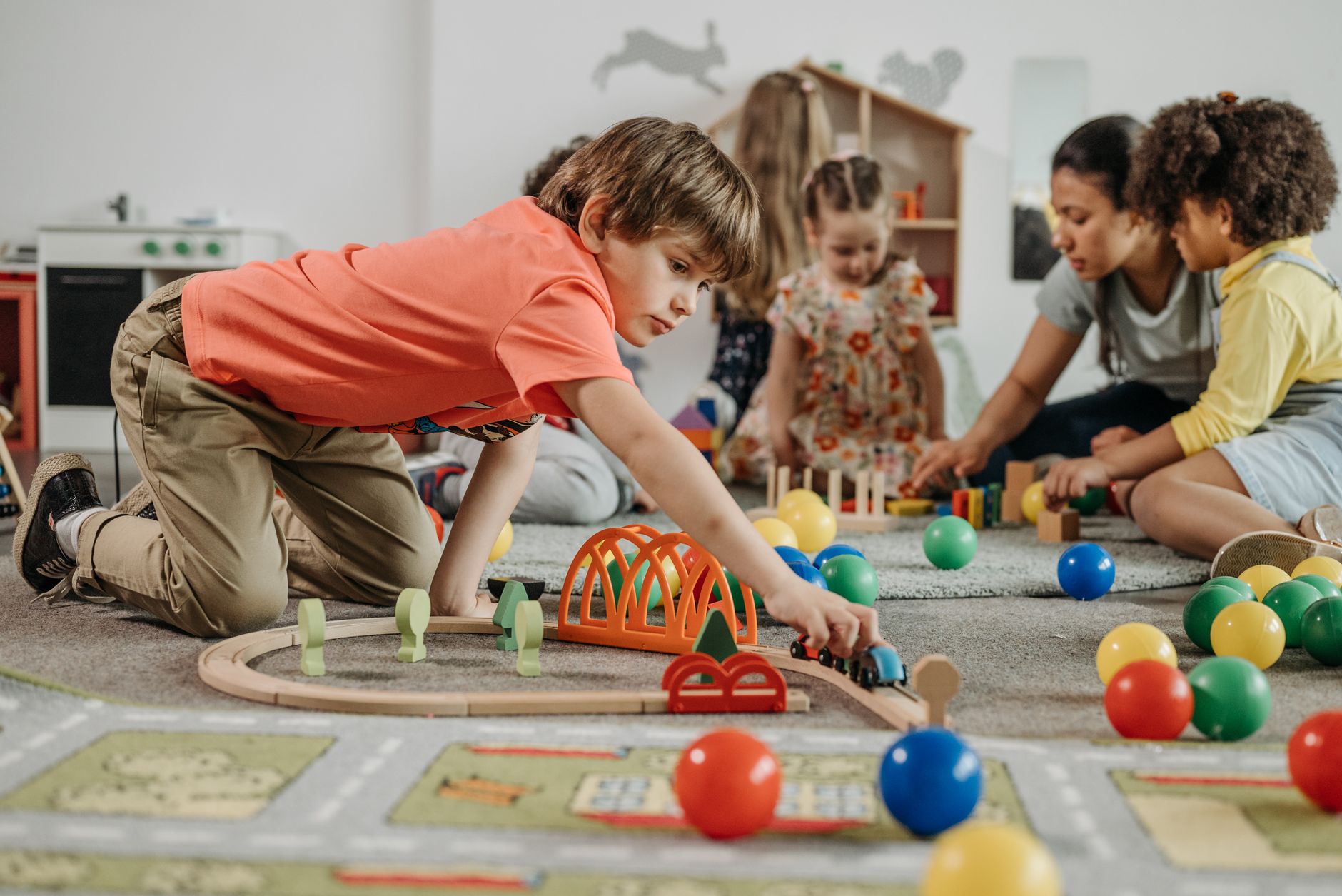
Do you have playtime in your class?
Are you wanting to start?
My goal is to have a variety of types of play throughout the day, the play that I’m writing about in this post is free play. It’s a time for the students to have unstructured time without teacher direction. I might have an activity or two that the children can choose to do but most often it is just them and the toys. I have other times during the day that I will direct the play but this time is student led.
In my district, kindergarten students start at 2 hours and build up to the full day in the first seven days of school. The first few days I will have 30 minutes of play and gradually increase so that by the end of the first month I’m at 60 minutes.

Some days I might have two play times during the day instead of one longer period. This is based on the student’s stamina and the other things planned during the day.
My idea playtime is after lunch. Everyone comes inside, meets at the carpet for a couple of songs and then I release them to play. 55 minutes later I give a five-minute warning, then we clean up and meet back at the carpet. This gives me opportunities to preload anything that I need to and to wrap up or reflect on our playtime.
When I first start playtime in the year, I will ‘open’ some of the toys. By open, I mean that they are available for the children to play with. I use the terms open and closed to clearly define what they are allowed to use.
I take the toys out and put them in the areas that I would like them to be played with. I then take the students on a tour of the open toys. We will gather around each option; I will tell them one way that they can use the materials and how to clean it up. I then ask for their ideas. After touring each option, I release them to play.
I will keep this format until the class shows me that they are responsible with the toys, with each other and are competent at cleaning up. The clearer I am with my expectations the easier this time is for all of us.

The format for my playtime is
- Go over expectations and/or what toys are open. This is only important to do until the students all know what to do. Occasionally, I will have one student that I do this with and the rest are able to just start playing.
- Release students to play.
- See below what I do during playtime.
- Give a 5-minute warning. I will loudly say, “Five more minutes.” They repeat and then I will add “It might feel like a long time or it might feel like a short time.” Last year my students also repeated this part and it was super cute.
- I signal clean-up with “Tootsie Roll, lollipop, we’ve been playing and now it’s time to stop.” It’s a Dr. Jean Feldman attention grabber – I saw her years ago and still use many of the things that she taught me. I will add a link to her YouTube page.
- I either actively clean-up or I will do magic spot. We have a system at my school, where students can earn a ‘eagle eye’. These are collected and the principal does a draw every two weeks or so and students can win a smelly pencil. Most of the time, I will pick four things and then fudge it a little so most students will earn an eagle eye once a week or two.
My role during playtime depends on the students in the class.
- Observation – watching the children and taking note of things that we can build upon. For example, I might notice that the students are starting to build a zoo so I will make sure that they have enough animals for all students to enjoy playing.
- Interference – being able to stop a problem before it becomes big – hopefully before it becomes a problem at all. This is where I notice who needs more support while playing.
- Modelling – I will join a group and side-by-side play and show how something can be used. For example, I might join the children playing with the dollhouse and act out one of the characters. Sometimes just hearing the role will encourage students to take on their own role.
- Playing – I often do this with Lego. I just start building, talking about what I’m doing. I will complement others, and talk about what my creation can do.
- Small group or individual learning – Generally, I’m the only adult in my class so I will have to do teaching while the children play. This is also the best time for me to do assessment. I like to work with students for a few minutes and then do a walk around of the class. Most students don’t notice that I’m even working at my table with these check-ins.

Each group of students has differing needs so my role is never the same each year. It will often change throughout the year, as well. I might only need to model early in the year, or I might need to model each time a certain toy is used until students are able to self-regulate or I might need to model for a specific student or small group of students.
As I was writing this, I kept coming up with more things that I want to write about play. Check back to see if I’ve added more.
Take care, Tracey



Leave a Reply